A standard game drive follows the roads and hopes for a sighting. Predator tracking goes out with the researchers who monitor Queen Elizabeth National Park’s lions, using radio telemetry to find collared animals wherever they are that morning — including places ordinary vehicles do not go.
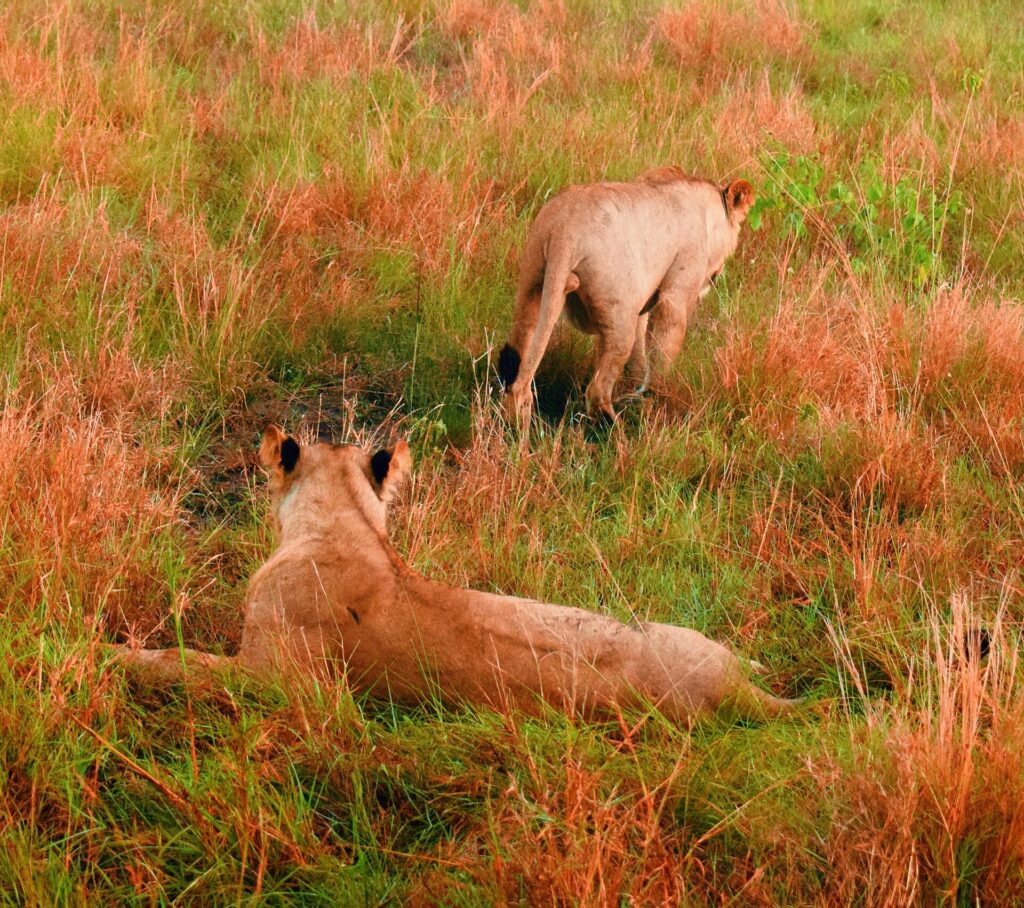
Lions resting in red grass, Queen Elizabeth National Park
The research is run by the Uganda Carnivore Program, which has studied the park’s lions, leopards and hyenas for decades, and the experience is offered through the Uganda Wildlife Authority as part of its research-tourism programme. Numbers are kept small, and the fee supports the monitoring work itself.
WHEREKasenyi Plains, northern Queen Elizabeth National Park
WHENEarly morning, with evening sessions sometimes available
DURATIONRoughly one to three hours, depending on how quickly the animals are found
GROUP SIZESmall groups, limited vehicle places per session
THE MORNING
How a Session Works
You meet the researcher before sunrise and head out onto the Kasenyi Plains, the open grassland where Queen Elizabeth’s lions hunt Uganda kob. The researcher uses a directional antenna to pick up the signal from collared lions and guides the vehicle towards it, explaining what the data shows about each pride’s movements, territory and health.
Once the lions are found, you stay with them while the researcher records their condition and behaviour. The conversation is the part most guests remember: the conflict between lions and cattle herders on the park boundary, the poisoning incidents that have hit the park’s lion population, and what the monitoring is doing to prevent them.
Sightings are not guaranteed — the lions are wild and free-ranging — but tracking them by signal gives far better odds than a standard drive.
GOOD TO KNOW
Planning This Experience
Places are limited, so this must be booked in advance through the Uganda Wildlife Authority, which we arrange as part of your itinerary. The fee is set by UWA and confirmed when we book.
It combines naturally with an afternoon boat trip on the Kazinga Channel and a stay at Kyambura Gorge Lodge or Mweya, all covered on our Queen Elizabeth Game Drive & Boat Cruise page. For a research experience with a different species, the park also runs mongoose tracking with the Banded Mongoose Research Project.
Is predator tracking the same as a game drive? No. You travel with a researcher, use radio telemetry to find collared animals, and can go off the standard tracks with permission. It is more focused, and the commentary is scientific rather than general.
Will we definitely see lions? Not definitely. Tracking collared animals gives much better odds than a regular drive, but the lions are wild and sightings can never be guaranteed.
Can we see the tree-climbing lions too? The tree-climbing lions are in the Ishasha sector in the south of the park, a separate drive. Many itineraries pass through Ishasha on the way to Bwindi.
Are children allowed? Age rules are set by UWA and can change. Tell us the ages in your party and we will confirm before booking.