

June 20, 2026 · 5 min read
Photo: Rod Waddington, CC BY-SA 2.0
Mountain Gorilla Intelligence — The Science Behind What You See
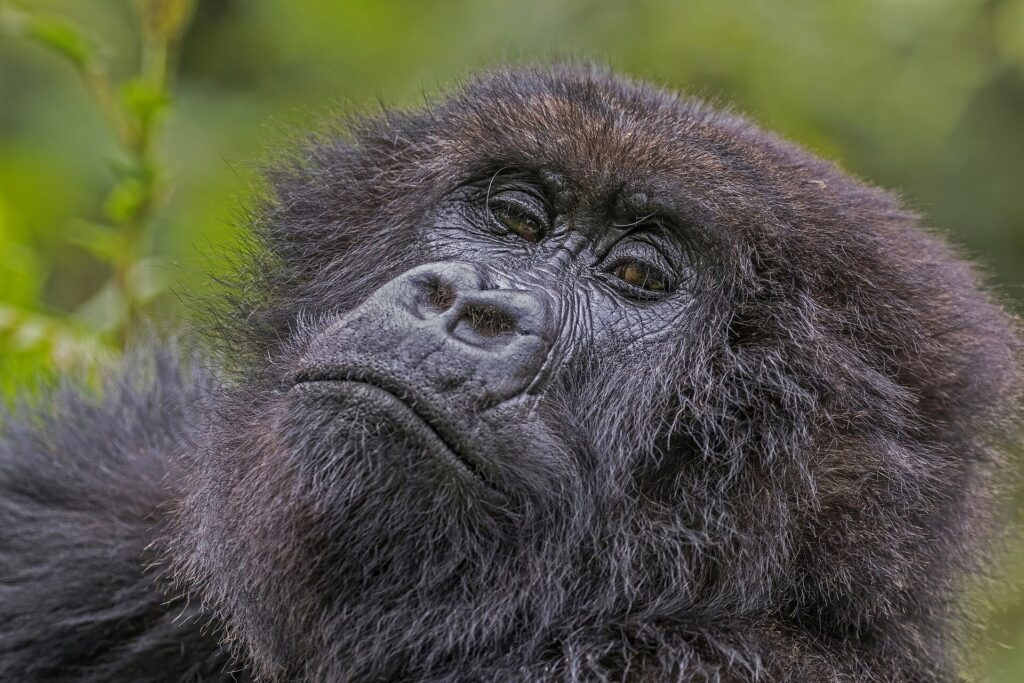
The mountain gorilla’s apparent intelligence is one of the most compelling aspects of the gorilla trekking encounter — the sense that the animals behind those eyes are running some recognisable cognitive process, that the infant’s curiosity toward the visitor group is genuine rather than reflexive, that the silverback’s assessment of the morning’s visitors is more sophisticated than a threat-detection calculation. The science behind this intuition — the actual research findings on gorilla cognitive abilities — is both more interesting and more nuanced than the popular representation of gorilla intelligence typically conveys.
What Mountain Gorillas Are Not
Mountain gorillas rarely use tools in the wild — a capability that chimpanzees demonstrate extensively through nut-cracking, termite fishing, and sponging, and that was for many years considered a defining indicator of primate intelligence. The rarity of tool use in wild gorillas is not evidence of lower intelligence than chimpanzees; it is evidence of a different ecological niche. Gorillas are herbivores in an environment that provides their entire dietary requirement without the foraging problem-solving that drives chimpanzee tool use. In captivity, gorillas readily learn tool use and have demonstrated the capacity to use tools when given the opportunity — the absence of wild tool use reflects environmental context rather than cognitive ceiling.
Social Intelligence — The Research Evidence
The aspect of mountain gorilla intelligence that is most directly visible during the gorilla trek encounter is social intelligence — the complex, context-dependent management of social relationships within the family group. Long-term research at Karisoke and Bwindi has documented the following social cognitive capacities in mountain gorillas: reconciliation behaviours after conflict between individuals (one individual actively seeks proximity to a previously contested partner after a fight, reducing the post-conflict tension in a way that requires the cognitive representation of the other individual’s relationship state); coalition formation (individuals who are not directly involved in a conflict intervene in support of specific individuals in ways that reflect existing alliance relationships); and careful attention to who is watching, such as younger males and females keeping out of the dominant silverback’s sight when they interact.
Memory and Individual Recognition
Gorillas in the wild maintain long-term individual recognition of other gorillas — including individuals from groups they have not had contact with for years, in the context of inter-group encounters that reestablish previous relationships. The female transfer behaviour that produces gorilla group gene flow requires exactly this capacity: a young female assessing a rival silverback’s suitability must be drawing on memory of previous encounters and observations of that silverback’s behaviour, sometimes observed months or years before the transfer decision. The long-term monitoring data from Karisoke provides the longitudinal record that makes this inference possible.
Emotional Expression
The emotional expression capacity of mountain gorillas is the aspect that most affects the quality of the gorilla trekking encounter for human visitors — the play expressions, the apparent contentment of nursing mothers, the clear frustration vocalizations of a juvenile that loses a competition for a food item. These emotional expressions are not simply behaviours that resemble human emotions; they appear to reflect the same underlying affective states that human emotion concepts were developed to describe, produced by neural systems that share a common evolutionary origin. The 98.3% DNA shared between mountain gorillas and humans is not merely a genetic statistic — it is the quantified genetic basis for the shared affective systems that make gorilla emotional expression legible to human observers in a way that fish or insect behaviour is not.
Intelligence You Can See on a Trek
- Food processing. Watch how gorillas strip leaves from a stem, fold nettles so the stinging hairs face inward, or peel bamboo shoots. These are learned, multi-step techniques that young gorillas pick up by watching adults.
- Reading the group. Juveniles glance at the silverback before approaching visitors, and the family follows his lead when he decides to move.
- Communication. Soft grunts and belches keep the family in contact; a sharp pig-grunt is a warning. Rangers use the same sounds to reassure the gorillas.
- Play. Wrestling, chasing and mock charges between young gorillas are how social skills are learned.
Mountain Gorilla Intelligence FAQs
Are gorillas as intelligent as chimpanzees?
They are equally capable in different ways. Chimps use more tools in the wild because their diet rewards it; gorillas show sophisticated social intelligence and food-processing skills.
Do gorillas recognise people?
Gorillas recognise individual group members for years, and habituated gorillas appear to recognise rangers and trackers who visit them daily.
Can gorillas learn sign language?
Some captive gorillas were taught to use signs, but scientists still debate how far this resembles human language.
Ready to start planning? Browse our Rwanda & Uganda safaris or contact us to build your itinerary.
Ready to Plan Your Private Gorilla Trip?
Tell us your dates and what you're hoping to experience — we reply within 48 hours with a bespoke proposal. Not ready to book? We're happy to answer questions first.
START PLANNING ↗More on Gorilla Species & Conservation
- Mountain Gorilla Group Size — How Many Gorillas in a Family and Why It Varies
- East Africa Conservation Tourism — How Your Safari Spending Funds the Wild
- Mountain Gorilla Body Size — How Big Do Silverbacks Actually Get?