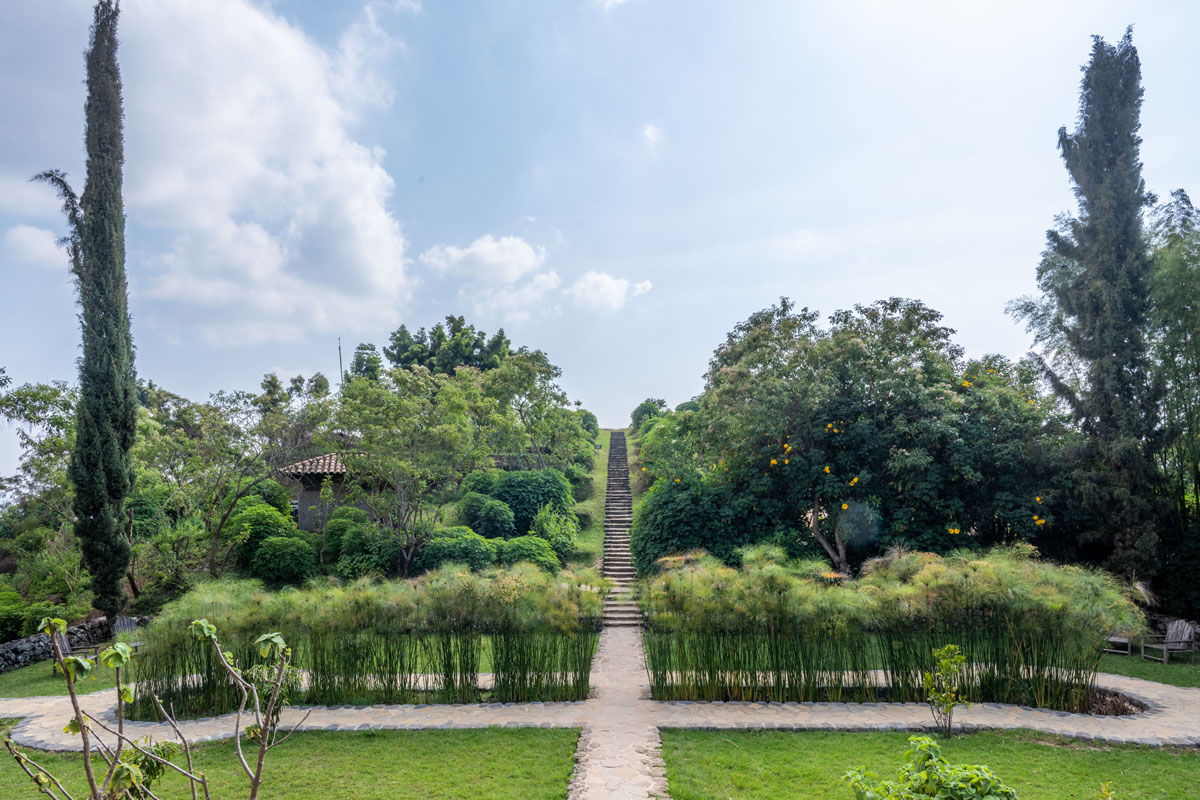
Buhanga Eco-Park protects a small, sacred stretch of ancient forest that once served as Rwanda’s royal coronation ground. A guided nature walk explores the forest and its cultural history for $40 per person, while a full-day picnic option, with an optional camping add-on, is available for $60 per person.
A relaxed, low-key half-day or full-day option, and one of the few Volcanoes NP add-ons open to younger children.
STARTING POINTBuhanga Eco-Park gate, roughly 20 minutes from Musanze town.
BEST TIME TO GOYear-round; dry season is most comfortable for the full-day picnic option.
DIFFICULTYEasy — flat, short walking trails suitable for most ages.
WHAT TO BRING
Pack List
Comfortable shoes
Sun hat and reusable water bottle
Picnic essentials if booking the full-day option (or ask us to arrange it)
A Sacred Forest With a Royal History
Buhanga was traditionally used as Rwanda’s royal
coronation ground, a role that made the forest itself sacred long before it became protected as an eco-park
— local tradition holds that kings were once crowned here, and the site retains a cultural weight in the
surrounding community distinct from a purely ecological protected area. Unlike Volcanoes National Park’s
larger forest zones, Buhanga is small and easily explored on foot, making its cultural history, rather than
wildlife density, the primary draw for most visitors.
Your guide typically weaves the site’s royal history
directly into the walk itself — specific clearings and landmarks connected to coronation traditions,
alongside the more general forest ecology of the small reserve.
WHO IT’S FOR
A Rare Family-Friendly Add-On
With a minimum age of just 7 for the nature walk,
Buhanga is one of the very few Volcanoes National Park activities genuinely accessible to younger children
— gorilla trekking, golden monkey trekking, and every volcano hike in the range require a minimum age
of at least 12, and most 15. For families travelling with younger children who can’t join the main
wildlife activities, Buhanga offers a genuine, culturally rich outing rather than a consolation activity,
and the full-day picnic option extends that into a relaxed family day out.
Nature Walk vs. Full-Day Picnic
The $40 guided nature walk is a focused half-day activity
covering the forest’s ecology and royal history in a couple of hours — a straightforward, easy
addition to a day that also includes another activity. The $60 full-day picnic option extends the visit
considerably, adding relaxed time within the forest and an optional camping add-on for families or groups
wanting a genuine overnight experience in a genuinely low-key, low-altitude setting compared to the
higher-elevation camping required for Mt Karisimbi.
Frequently Asked Questions
Is this suitable for a rest day between gorilla treks?
Yes — its relaxed, low-physical-demand format makes it a genuinely restful contrast to the more
strenuous activities elsewhere in the park, ideal for a day without a demanding trek scheduled.
What should we expect from the camping
option?
A low-key overnight within the eco-park itself, considerably gentler than the high-altitude camping required
for Mt Karisimbi — a good option for families or groups wanting a taste of camping without the
demanding conditions of a genuine mountain overnight.
Do we need to be physically fit for the nature
walk?
No — unlike gorilla trekking or the volcano hikes, Buhanga’s terrain is gentle and the walk itself
undemanding, which is precisely what makes it accessible to younger children and less mobile family members.
Can very young children join, below age 7?
The stated minimum age of 7 applies to the standard nature walk; we can discuss specific circumstances for
younger children directly, though the park’s guidance should generally be followed for safety and
experience reasons.
How does this fit into a wider Volcanoes
National Park itinerary?
Most guests add Buhanga on a day between gorilla trekking and a volcano hike, or specifically to give younger
family members an activity while other members of the group do the demanding hikes on a separate day.
Is there anything to see besides the forest
itself?
Yes — alongside the natural forest ecology, the site’s specific royal-coronation landmarks and
the cultural context your guide provides are as much a part of the visit as the walk through the trees.
How long does the guided nature walk take?
Typically around two hours, making it easy to combine with another shorter activity or simply treat as a
relaxed standalone half-day outing.
WHY IT’S WORTH ADDING
Culture and Rest, Not Just Wildlife
Most Volcanoes National Park itineraries are built
almost entirely around wildlife — gorillas, golden monkeys, the volcano hikes — leaving relatively
little room for the human and cultural history of the region. Buhanga fills that gap directly, offering
genuine insight into Rwanda’s pre-colonial royal traditions within a genuinely restful, low-demand
setting. For families balancing different fitness levels and interests, or any traveller wanting a change of
pace from consecutive demanding trekking days, it’s a meaningful, easy-to-justify addition at a
modest price point relative to the park’s other activities.
Planning a Buhanga Visit
Buhanga is close enough to Kinigi and the main Volcanoes
National Park lodges that it requires only a short transfer, making it easy to slot into a rest day or combine
with a lighter morning activity. Because the site is small and the walk itself gentle, no special fitness
preparation is needed — comfortable walking shoes and normal outdoor clothing are sufficient for either
the half-day nature walk or the full-day picnic option, and the optional camping add-on requires only basic
gear rather than the specialised cold-weather equipment needed for a high-altitude overnight elsewhere in the
park.
Combining Buhanga With Musanze Caves
Buhanga sits close enough to
Musanze Caves that many guests combine the two into a single relaxed day — both are low-physical-demand,
culturally interesting activities within a short drive of each other and of the main Kinigi lodge cluster,
making them a natural pairing for a rest day between more strenuous trekking or hiking days. Both also share
the same broadly family-friendly accessibility that sets them apart from most of the park’s wildlife
activities.
What Makes the Site Different From a Standard Nature Reserve
Rwanda has no shortage of protected forest, but Buhanga’s
specific status as sacred royal ground gives it a cultural dimension most small reserves lack — local
communities still regard the site with a degree of reverence tied to its coronation history, and that context
shapes how the walk is presented rather than treating the forest purely as an ecological curiosity. For
travellers interested in Rwanda’s pre-colonial history and monarchy, alongside its more widely known
post-genocide recovery story, Buhanga offers a rare accessible window into that older tradition, one that
complements the country’s better-known conservation and recovery narratives rather than repeating them.
The forest and its birdlife also offer a pleasant, undemanding walk on their own terms even for guests less
drawn to the specific history, making it a reliably worthwhile addition regardless of how deep your interest
in Rwanda’s pre-colonial past runs, and one that consistently receives positive feedback from guests who
added it somewhat as an afterthought to their main trekking itinerary, often noting afterward that it was a
welcome change of pace they hadn’t expected to enjoy as much as they did, precisely because it asked so
little of them physically after several demanding, consecutive trekking days spent elsewhere in the park and
in the wider Volcanoes National Park area more generally.